This article explains PG I, PG II, and PG III, where the PG comes from, how it appears in UN package marks, and why PG mismatch can lead to rejected cargo or shipment delays.
VCEN note
For dangerous goods export, the answer is rarely based on one document alone. Cargo attributes, packaging, carrier acceptance, port requirements, and declaration documents should be reviewed together before booking.
Why PG is a key field in dangerous goods export
In dangerous goods export, three fields are essential: UN number, hazard class, and Packing Group. Many shippers focus on the UN number and hazard class, but overlook PG. In practice, PG directly affects packaging strength, freight cost, and carrier acceptance.
PG is not selected by the shipper. It is determined by the intrinsic hazard of the product. However, exporters still need to understand it because packaging, declaration, booking review, and cost estimation all depend on it.
Common mistake
Some customers receive the UN number and assume the shipment is ready, only to discover later that the UN package mark does not match the cargo PG. For example, PG II cargo packed in a Z-rated package may be held during terminal inspection.
PG I, PG II, and PG III
IMDG Code divides applicable dangerous goods into three packing groups by hazard severity. Not every class uses the PG system. Class 1, Class 2, Class 5.2, and Class 7 generally do not use packing groups.
| Packing group | Hazard level | Typical packaging mark | General meaning |
|---|---|---|---|
| PG I | High danger | X | Requires the strongest UN packaging performance |
| PG II | Medium danger | Y | Requires medium-strength UN packaging performance |
| PG III | Lower danger | Z | Requires lower-strength UN packaging performance |
PG I - High danger
PG I substances have high danger and require the strictest packaging performance tests. Examples include certain highly flammable liquids, highly toxic chemicals, and strong corrosives.
PG II - Medium danger
PG II is common in export operations. Many paints, thinners, adhesives, sodium hydroxide products, and corrosive liquids may fall under this level depending on test data and concentration.
PG III - Lower danger
PG III indicates lower danger, but it is still dangerous goods. Diesel, kerosene, some high-flash-point coatings, and some weaker corrosives may be PG III depending on product data.
Key rule
The UN package mark must meet or exceed the cargo PG requirement. PG I cargo can only use X-rated packaging. PG II cargo can use X or Y. PG III cargo can use X, Y, or Z.
Where does PG appear in the UN package mark?
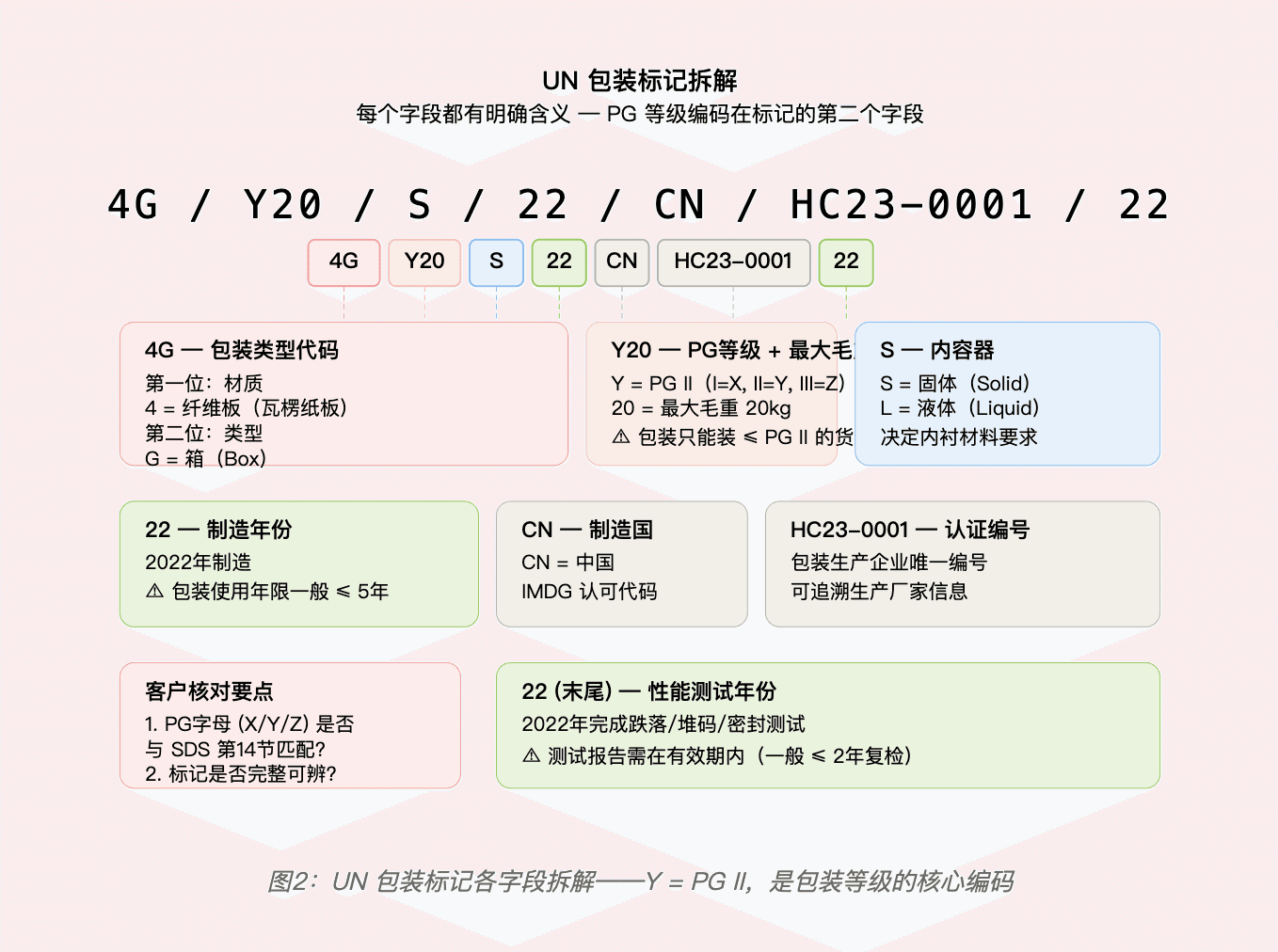
PG information appears in the second field of the UN package mark. For example, in the mark 4G / Y20 / S / 22 / CN / HC23-0001 / 22, the Y in Y20 means the package is suitable for PG II cargo, and 20 means the maximum gross mass is 20 kg.
| Cargo PG | Allowed package mark | Not allowed |
|---|---|---|
| PG I | X | Y, Z |
| PG II | X, Y | Z |
| PG III | X, Y, Z | — |
Most common error
If the cargo is PG II but the package mark is Z, the package rating is not sufficient. This can lead to cargo being held during port or terminal inspection. Using X packaging for PG III cargo is allowed, but often increases cost unnecessarily.
PG checklist before shipment
| # | Checkpoint | Status |
|---|---|---|
| 1 | Does SDS Section 14 clearly show the packing group? | □ |
| 2 | Does the product class use the PG system? | □ |
| 3 | Is the PG consistent with flash point, toxicity, or corrosivity data? | □ |
| 4 | Is the PG consistent with SDS Section 2 hazard classification? | □ |
| 5 | Does the UN package mark meet or exceed the cargo PG? | □ |
| 6 | Is the UN package mark complete and readable? | □ |
| 7 | Has the SDS been updated after concentration or formula changes? | □ |
| 8 | Is the packaging test report still valid? | □ |
How VCEN supports packaging compliance and shipment matching
- SDS Section 14 PG review: check whether the PG is complete and internally consistent.
- IMDG DGL comparison: compare the PG against the UN entry in the Dangerous Goods List.
- UN package mark review: confirm whether X, Y, or Z satisfies the actual cargo PG.
- Packaging supplier coordination: help customers source compliant UN packaging when existing packaging is not suitable.
- Carrier matching: match PG, cargo class, route, and carrier acceptance to reduce booking rejection risk.
VCEN reminder
PG is not something customers need to calculate by themselves, but it is the key connection between SDS, IMDG DGL, and UN package marks. VCEN helps customers verify this chain before shipment.
Case reminder
SDS Section 14 and flash point data conflict
A customer exported a coating under UN1263, Class 3. SDS Section 14 showed PG III, but Section 9 showed a flash point of 19 degrees Celsius. During DG review, the carrier found that the product should be reviewed as PG II based on flash point data, so the SDS was rejected and a corrected version was required.
Lesson
Internal SDS consistency is the first carrier review checkpoint. If Section 14 says PG III but Section 9 supports PG II, the SDS is not reliable for transport review.
Key points
PG is one of the three key DG export fields together with UN number and hazard class.
PG should come from SDS Section 14 and must be consistent with physical and hazard data.
UN packaging marks use X, Y, and Z to indicate the packing group level the package can support.
Packaging must meet or exceed the cargo PG requirement. A lower-rated package can cause rejection.
Concentration and formula changes may change the PG, so SDS and packaging should be checked again.