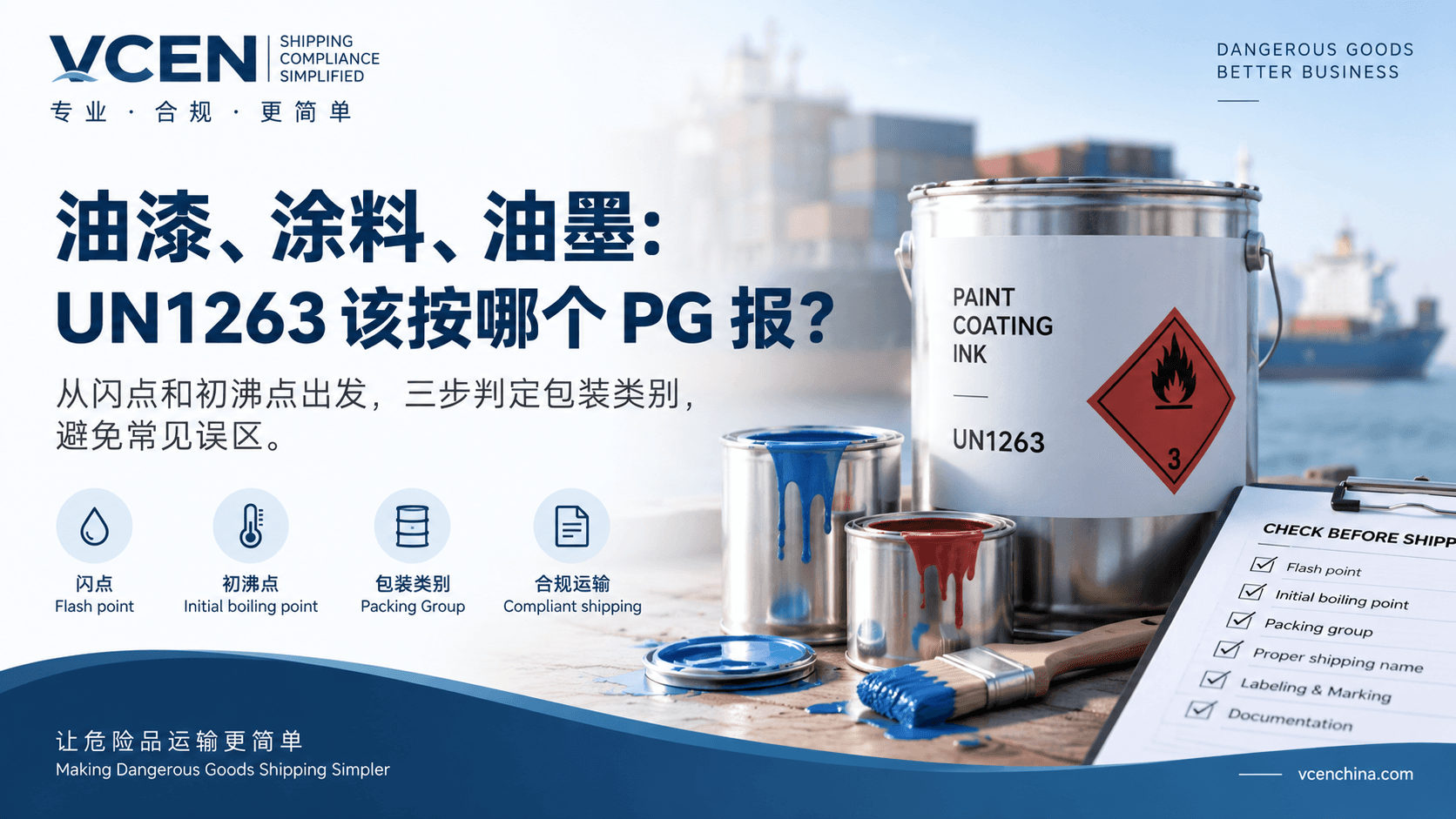
A packing group declared too low means packaging below the standard; too high, it costs money and space. This article shows how flash point and boiling point decide the grade.
VCEN note
For dangerous goods export, the answer is rarely based on one document alone. Cargo attributes, packaging, carrier acceptance, port requirements, and declaration documents should be reviewed together before booking.
Why this matters
In the Dangerous Goods List, UN1263 is not one product with one packing group. It appears under three separate packing groups, each with different packing instructions, packaging performance requirements, quantity limits, and stowage conditions.
The practical consequence is direct. Declare the packing group too low and the cargo may be shipped in packaging that does not meet the required performance standard. Declare it too high and the shipment may face unnecessary packaging cost, tighter quantity limits, or booking difficulty.
Operational risk
For paint, coating, varnish, thinner, and related materials, the question is not only whether the cargo is UN1263. The entry, packing group, flash point statement, and packaging documents should all be aligned before booking.
UN1263 is a generic entry, not a single product
The Proper Shipping Name for UN1263 is PAINT or PAINT RELATED MATERIAL. It covers paint, lacquer, enamel, stain, shellac, varnish, polish, liquid filler, liquid lacquer base, and paint thinning or reducing compound when the cargo is a Class 3 paint-type product without a more specific named entry.
It is not a catch-all for every product placed in a paint can. Choosing the wrong neighbouring entry is still a misclassification.
| UN number | Entry point | Class |
|---|---|---|
| UN1263 | Paint, coating, varnish, and related material | Class 3 |
| UN3066 | Paint or paint related material, corrosive | Class 8 |
| UN3469 | Paint, flammable and corrosive | Class 3, subsidiary Class 8 |
| UN3470 | Paint, corrosive and flammable | Class 8, subsidiary Class 3 |
| UN1210 | Printing ink and printing ink related material | Class 3 |
Core concept
Settle the entry before the grade. If the product is corrosive or is printing ink, UN1263 may not be the correct starting point.
The packing group turns on closed-cup flash point and initial boiling point
Class 3 packing groups are assigned from two data points: closed-cup flash point and initial boiling point. Flash point alone is not enough.
| Packing group | Closed-cup flash point | Initial boiling point |
|---|---|---|
| PG I | Any value | ≤ 35 °C |
| PG II | < 23 °C | > 35 °C |
| PG III | ≥ 23 °C and ≤ 60 °C | > 35 °C |
- PG I is decided by initial boiling point, not by flash point.
- The line between PG II and PG III is whether the flash point is below 23 °C.
- All three groups still depend on initial boiling point, so a flash point without an initial boiling point is incomplete.
The flash point value used for this review should be closed-cup data. Open-cup values typically read higher and should not be substituted directly.
Additional hazard reminder
If the cargo has an additional hazard, the final packing group should also reflect the severity of that additional hazard where the rules require it. A flash point in the PG III range does not automatically guarantee a final result of PG III.
The two special routes for viscous liquids
Paints, enamels, lacquers, varnishes, adhesives, and polishes may be viscous flammable liquids. Beyond the standard assignment, the IMDG Code provides two special routes with different consequences.
Downgrade route: flash point below 23 °C may still be PG III
A viscous flammable liquid with a flash point below 23 °C would normally fall in PG II, but it may be placed in PG III if all required viscosity, solvent separation, toxicity or corrosivity exclusion, and receptacle-capacity conditions are met.
| Review point | What to confirm |
|---|---|
| Viscosity | Flow time matches the applicable viscosity table |
| Solvent separation | The separated solvent layer is within the allowed limit |
| Other hazards | The mixture and separated solvent do not meet Class 6.1 or Class 8 criteria |
| Receptacle capacity | No more than 30 litres for sea transport under the IMDG Code route |
Sea transport red line
The 30-litre receptacle limit is the sea transport point to check. Do not apply the 450-litre road transport threshold to an IMDG sea shipment.
Exemption route: the consignment may not be dangerous goods at all
Some viscous liquids with flash points between 23 °C and 60 °C may be outside the IMDG dangerous goods requirements if the composition, viscosity, solvent separation, nitrocellulose, and receptacle-capacity conditions are all met.
Do not mix up the two routes
Downgrading to PG III and being exempt from the IMDG Code are legally different results. Each must be supported by test data, not by a verbal statement that the product is thick or water-based.
What to confirm in advance
- Closed-cup flash point in degrees Celsius.
- Initial boiling point in degrees Celsius.
- Test method, especially whether the flash point is closed-cup data.
- Section 3 composition of the SDS, to check whether Class 6.1 or Class 8 components may affect the entry.
- Section 14 transport information of the SDS, including UN number, Proper Shipping Name, class, packing group, and EmS.
- Capacity of the individual receptacle, especially if viscous liquid rules may be used.
- Viscosity flow time and solvent separation test results when a downgrade or exemption route is being considered.
The most common information gap is a flash point without an initial boiling point. The next common issue is an open-cup flash point being used as if it were closed-cup data.
Common misconceptions
Misconception 1: paint always means UN1263
Not always. Printing inks, corrosive coatings, and flammable corrosive coatings may belong under other entries. The entry must be reviewed before the packing group.
Misconception 2: a flash point on the SDS is enough
It is not enough. PG I depends on initial boiling point, and PG II or PG III also requires the initial boiling point condition. Without both data points, the grading basis is incomplete.
Misconception 3: viscous liquids can always be downgraded
The viscous liquid route has specific test-data and capacity conditions. It cannot be applied simply because the product appears thick.
Misconception 4: the base paint and thinner can always be declared together under one simple line
Special Provision SP 367 may affect how the name is written when paint and paint related material are in the same package, but it does not remove the need to assign the packing group from the most severe item.
Misconception 5: a supplier's verbal statement is enough
The review should be based on SDS data, flash point, initial boiling point, viscosity, solvent separation, and other verifiable test results. A verbal non-DG conclusion is not a transport classification basis.
Practical checklist and VCEN support
Step 1: Collect the required data
- Closed-cup flash point.
- Initial boiling point.
- SDS Section 3 composition.
- SDS Section 14 transport information.
- Receptacle capacity.
- Viscosity and solvent separation data if a special route is being considered.
Step 2: Settle the entry before the grade
If the product is corrosive, start by reviewing the Class 8 or flammable-corrosive entries. If it is printing ink, review UN1210. Only after the cargo is confirmed as UN1263 should the packing group be assigned from flash point and initial boiling point.
Step 3: Check the document line
Flash point on the transport document
Where the primary or subsidiary hazard is Class 3 and the closed-cup flash point is 60 °C or below, the minimum flash point should be shown in brackets immediately after the packing group, for example: UN 1263, PAINT, 3, PG III, (25 °C c.c.).
VCEN can help review paint, coating, varnish, thinner, and related material documentation, checking the UN number, Proper Shipping Name, hazard class, packing group, flash point statement, packaging condition, and sea transport declaration requirements before booking.
Key points
The packing group is determined by closed-cup flash point and initial boiling point together; flash point alone is not enough.
PG I is decided by initial boiling point, while the line between PG II and PG III is whether the flash point is below 23 degrees Celsius.
Under the IMDG Code, the viscous liquid concession stops at 30-litre receptacles, not the 450 litres used for road transport.
Inks go under UN1210, and corrosive coatings may fall under UN3066, UN3469, or UN3470 instead of UN1263.
Where the primary or subsidiary hazard is Class 3 and the closed-cup flash point is 60 degrees Celsius or below, the minimum flash point must appear after the packing group on the transport document.